

Over the past few years when I’ve been talking to founders, graduate students, investors, and industry incumbents one consistent theme has emerged: there is still a big disconnect from the laboratory level scientists and engineers trying to commercialize their research. I’ve wanted to try and address this gap with a comprehensive guide to trying to figure out if your PhD thesis or postdoc project could be a company.
There are some useful resources that I will link near the end, but in my opinion some go very deep in a particular area and some are committed programs that span weeks. I wanted something with low commitment that some students could print out one weekend and spend some weeks trying to figure it out if their research could become a company. One caveat here is that if you are at a university or research institute there may be some intellectual property considerations that you need to talk through with your institution. This may delay publishing and talking to future customers and you may need some training on how to hold confidential information and not disclose your potential trade secrets or inventions. If you think you’re sitting on the next best thing, a good place to start before here is a patent lawyer.
I’ve kept this guide mostly focused on chemistry, but it’s very general. Feel free to insert your own chemistry, biology, translational research, or whatever sort of laboratory focused science you have cooking away. This is not legal advice. Laboratories can be dangerous. This post is also really lengthy. Feel free to dive in as needed or just use it as a reference.
Before we get into it, there are some cool career opportunities that I’m seeing for anyone looking for a job:
1. The Problem
Academic research usually begins with a scientific question and a funding proposal. Some projects seek a fundamental understanding of the rules that govern the world. Others attempt to solve a difficult scientific, technical, or societal problem. In either situation the goal is to do good science, but good science is not a product you can sell in the end.
My own PhD research sought alternatives to bisphenol A in epoxy resins, with the longer-term goal of developing new composite materials for wind turbine blades. The paradox of clean energy is that to make it happen we need to keep extracting and refining crude oil. My thesis tried to offer some solutions to that paradox. My research was technically interesting, and I produced some useful ideas and materials, but I did not develop a product. At best, I made base resins that might eventually have been formulated into something useful.
The lack of commercialization was not a failure because my thesis was not a product-development program. My thesis was an exploration of structure–property relationships in biobased epoxy resins. To be clear, you can have a successful academic stint as a scientist and never make a viable product. I just think you should have options.
Academic research is valuable because it creates knowledge from which products may eventually be built. It is generally framed around evaluation of fundamentals or proposing technical solutions to big societal problems—not proving that those solutions can become viable businesses. A publication in Science or Nature might be groundbreaking and help provide the foundation for a new company, but groundbreaking research is not evidence that the underlying research can be commercialized successfully. Great science is not a product that a customer can buy and deploy at scale.
It’s hard enough to do research and even harder to make a product from that research. My bet has always been that a scientist or engineer can grasp the fundamentals of turning their research into a product faster than a product person could learn to the necessary science or engineering. Your research might, for example, demonstrate a promising way to remove or destroy trace amounts of PFAS in water or to separate mixed plastics into useful material streams. You can develop a legitimate technical solution to an important problem without having created a viable business. A start-up could be a viable path, but it may not be the best way to unlock that value. An established company with the necessary infrastructure, customer access, and operational capabilities might be much better positioned to take the research and commercialize it. Even just getting your research patented could help fuel some licensing money in the future (see above about talking to lawyers).
A technically impressive idea can fail for many reasons:
Nobody needs it enough to pay for it.
Customers are unwilling to change their existing materials or processes.
The economics do not work.
The product cannot be manufactured in a safe and reliable manner at scale.
Customer qualification takes too long.
The addressable market is too small to support the business.
You can address every item on that list and still fail. Answering these questions early does not guarantee success. These answers will help reduce the risk of failure. Investors may lose their money, but you can lose years of your life while absorbing the stress and opportunity cost of building the wrong company.
My point is that basic research is important and needed and grants should be written for those purposes. You can start a company from basic research, but it’s tough to shift from good researcher to a product developer. The two things are closely aligned, but fundamentally different.
I think I can teach or guide anyone who wants to learn to make that shift at the laboratory level. I think of it as The Lean Lab (hence the title). You are no longer asking only whether your science is interesting or technically sound. You are asking whether it can become a product that someone is willing to qualify, purchase, and use. The problem shifts from a broad scientific or societal question to a more concrete one: What does a customer need, and what will that customer actually buy?
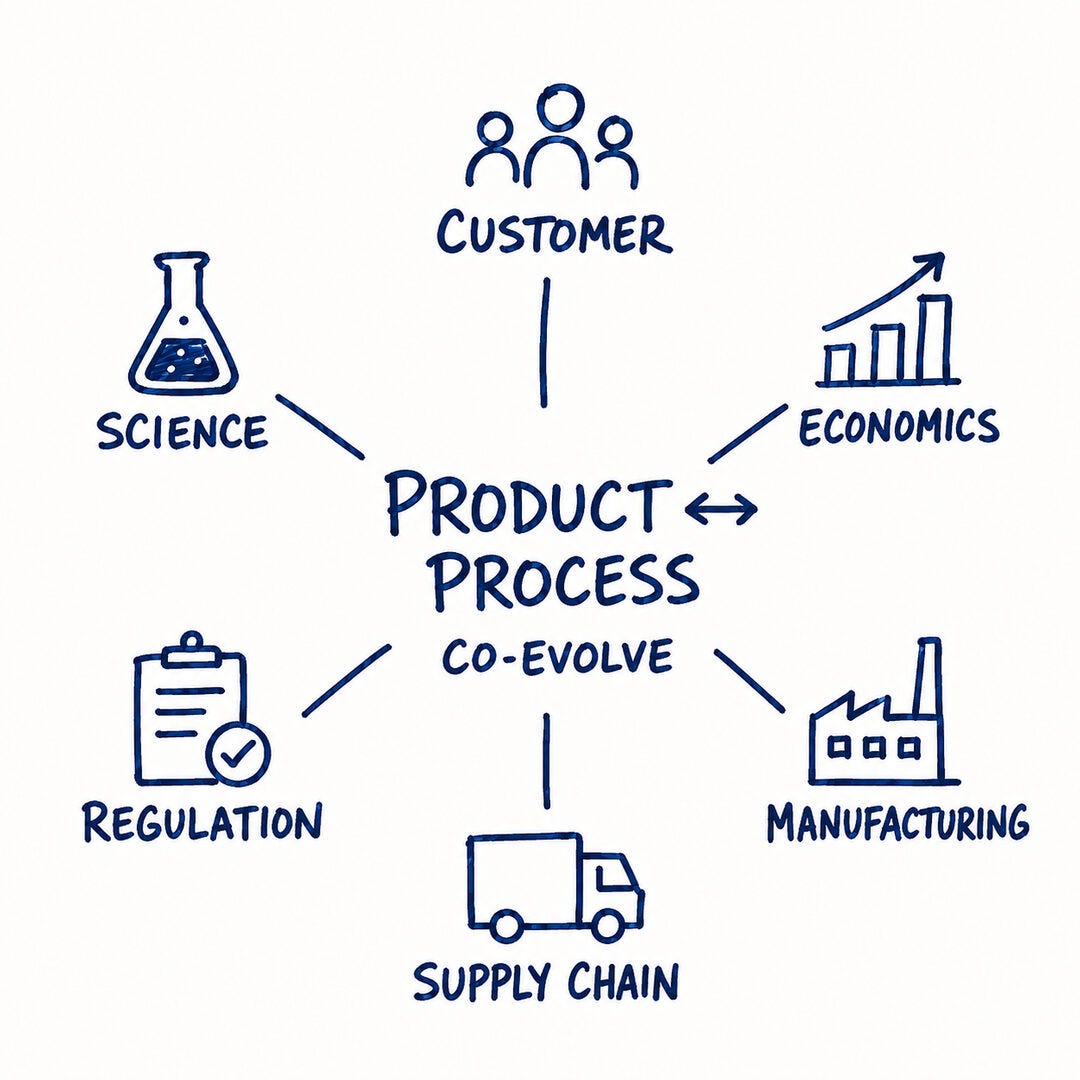
Your science remains the engine, but an engine is not a complete vehicle. You can’t drive an engine to the beach, but your car needs an engine before it can go anywhere. You need both to be there and to work together. A viable product also needs workable economics, manufacturing, supply chains, regulatory pathways, customer adoption, and capital. Testing those surrounding assumptions, while they are still relatively cheap to test, is the purpose of The Lean Lab.
2. What Is The Lean Lab?
I’m borrowing the name from Eric Ries’ The Lean Startup. If you haven’t read the book, or had someone quote it to you, the central argument is straightforward: founders should test their ideas quickly, cheaply, and directly with customers. Instead of building a complete product around a set of unproven assumptions, a team creates a minimum viable product, measures how customers respond, learns from the results, and adjusts before committing substantial time or capital.
The framework found a natural home in software because it fits the economics of digital product development. A small team can build something in a garage, launch it at relatively little cost, observe how people use it, and revise the product repeatedly. AI-assisted development has made that cycle even faster and more available to everyone. A single person could start a software company that designs, builds, launches, and revises a product several times in a single year. Theoretically completely running on vibes.
The familiar software version of The Lean Startup, however, does not translate well to deep tech, hard tech, techbio, frontier tech, or whatever else people are currently calling businesses built around physical science and engineering.
You cannot usually build one of these products in your garage without attracting attention from the fire marshal, environmental regulators, or perhaps law enforcement. A 55-gallon drum of mixed organic chemical waste sitting beside your lawn mower is a legitimate concern. So are flammable solvents, strong acids and bases, oxidizers, pressurized equipment, and chemical fumes venting into the suburbs.
More importantly, a chemical or materials product cannot always be launched in an incomplete form just to see what happens. The first meaningful prototype may require specialized equipment, carefully controlled conditions, extensive safety procedures, and months of testing. A software bug can usually be patched after launch. A chemical accident, failed customer qualification, or botched pilot production run is considerably harder to reverse and deal with and there is a real risk of people getting injured or pollution of the environment. Your goal here isn’t to fail fast, but to fail on paper or the micron scale so that even if it does blow up–it’s a really tiny explosion.
The Lean Lab tries to get you to think about these physical constraints and consequences while you have legitimate, authorized access to a laboratory or other specialized equipment. For the most part The Lean Lab is a paper exercise that may alter how you approach something in the lab. Testing the commercial assumptions surrounding your research doesn’t require a lab, but to make the same sort of iterative changes to a physical product requires real access that is hard to get.
The immediate goal should not be to start a company. It is to determine how your research might fit into a broader product development and commercialization effort. For some of you this might be your first foray into the product development process.
You may discover compelling reasons why your research should not become a standalone company. That is a useful result. You can move on without spending years trying to force the idea into a business. Alternatively, the technology might be better suited for licensing, a partnership, or development inside an established manufacturer. Perhaps the best outcome is not founding the next 3M, but getting 3M to license your technology, hire you, and get you to develop the product there.
My philosophy is that The Lean Lab should be a repeatable process. You can apply it to one idea, learn from the results, and then apply it to the next. The same habits also translate well to a scientific career inside an established company, where researchers are expected to build useful products, draft patents, and then maybe write a paper for your coworkers.
3. What You Can Test Without Raising Money
The following sections are presented sequentially for readability, but the work itself should not happen in a strict sequence. These questions are interconnected and should be explored at roughly the same time or out of order.
A conversation with a potential customer might change your product specifications. Those specifications might require a different manufacturing process, which changes your costs and supply chain. The new economics might then eliminate one market while making another more attractive. This might eventually feel like an agonizing game of Whack-A-Mole. Developing a strong foundation now will make your eventual customer conversations more specific, credible, and useful.
3.1 Build the First Economic Model
If you are working in a laboratory and creating something from several raw materials you should already have a reasonable understanding of what goes into your material or technology and what process steps are required to make it. Your first economic model translates that scientific understanding into an estimated cost per batch, per hour, or cost per kilogram. At a minimum, it should include:
Raw-material quantities and prices
Overall isolated yield
Consumables and processing losses
Hands-on labor
Total batch cycle time/cost to run your continuous process
Waste generation and disposal
The amount of usable product produced
The table below provides a simplified example for producing 10 kilograms of chemical product at an overall yield of 90%. That yield may be optimistic for an early-stage process, but it gives us a starting point. Think of this as a large laboratory batch or small pilot-scale scenario and not a prediction of mature commercial costs.
Preliminary Batch Cost Model
Here is a link to a rough model I sketched out. I would have put a table here, but it would be too big of an email to send out. I think once you understand the basics you can adapt from here and get more in-depth or less on your costing model. I don’t know your process or technology so this is meant to be an illustrative example only.
The specific numbers are less important than the structure of the model. The objective is to determine what it would cost to produce 10 kilograms under a defined set of assumptions. The model should be simple enough that you can change the raw-material prices, quantities, yield, labor, or cycle time and immediately see how the cost per kilogram changes.
One expected benefit of scale is that direct labor usually becomes a smaller percentage of the cost per kilogram. That does not mean the entire process becomes cheaper automatically, but scale up introduces operators (not necessarily a chemist), quality control, maintenance, waste handling, utilities, facility costs, and additional equipment. It also introduces the possibility of failure at scale.
A failed batch may need to be discarded, reprocessed, or “worked off” by blending it into future conforming production batches. Your first model does not need to account for everything though. Your first model just needs to get you into the right range of numbers to make the next step in the process.
Ideally, you should create three versions of the model:
What it costs to produce the material in the laboratory today (1 kg or 10 kg)
What it might cost at the next practical scale (1000 kg)
What the process would need to look like at a plausible commercial scale (20,000+ kg)
The laboratory gives you considerable freedom to understand what belongs in the bill of materials, how long each step takes, and which parts of the process create the most cost. Even the cost of consumables like filter paper (maybe a filter bag at scale), pH adjustment, or just the need to recrystallize can push the costs up considerably.
For example, imagine that your reaction operates at 10% solids in an expensive or hazardous solvent that must be removed through five hours of distillation. You may get a 90% isolated yield compared to your starting substrates, but your total reactor yield is closer to 9%. You may need to handle an enormous volume of solvent to produce a relatively small amount of product. That affects equipment size, energy use, solvent recovery, safety procedures, cycle time, and waste disposal. It could be a fundamental barrier to commercialization.
If you can make the real philosopher’s stone that turns lead into gold, perhaps the customer will tolerate those costs. Most products do not.
Your preliminary model will still omit a great deal. It may not include:
Equipment depreciation or capital recovery
Facility costs
Insurance
Heating, cooling, vacuum, or other utilities
Quality-control testing
Cleaning and changeover time
Packaging and transportation
Inventory and storage
Product stability and shelf life
Regulatory and environmental compliance
General business overhead
You do not need precise estimates for all of these costs yet, but you should identify them. Be explicit that your first calculation represents a preliminary direct batch cost, not a complete estimate of commercial cost of goods sold.
Once the basic model is working, identify the assumptions that have the largest effect on cost. Test a few optimistic and pessimistic scenarios:
Can I get the yield up from 75% to 95%?
What happens if the most expensive raw material doubles in price?
Can I cut the total cycle time from 48 to 12 hours?
What happens if one batch in ten fails?
Can I reuse unreacted raw materials or can I even recover them?
At this stage, understanding which variables control the economics is more valuable than producing a precise-looking estimate. Generally, the less stuff you can use the more cost you can remove. Can you do the reactions without solvent? Can you just distill off your excess material and recycle it for a future batch?
You should also avoid treating cost as an automatic predictor of selling price. Customers do not pay your cost plus an arbitrary percentage. They pay based on the value the product creates, the available alternatives, their switching costs (potentially higher than you think), and their negotiating power.
For initial screening, you can calculate the selling price required to achieve different gross margins.
If your estimated cost is $100 per kilogram then under a cost plus pricing model you might try and eke out 20, 30, or 40% if you’re lucky. Generally anything above 50-100% is just in a different category and you are providing value that cannot be found outside of your product. I’ve seen 100%+ cost models on products that I’ve worked on with the goal of just not making the next one worse in anyway.
Making something for a dollar and selling it for two sounds easy, but it’s incredibly difficult. Whether any customer will actually pay your prices is a separate question that your market and customer research must answer. Also, remember that all the numbers in here are hypothetical for this essay. If you are operating within a speciality polymer space you’re really looking at $2-5/kg for a sale price. Maybe higher if you’re selling additives or catalysts.
With an initial cost model and bill of materials in hand, you can begin evaluating the supply chain. Are the necessary raw materials available at the required purity and volume? Are they made by several suppliers or only one? What are the minimum order quantities, lead times, transportation constraints, and sources of price volatility? What’s the danger of storing these raw materials for long periods of time? A process that works technically may still be impractical if its critical inputs are unavailable at the right scale or too expensive to keep in storage.
If your concept/technology survives this first screening and you think you need a more rigorous analysis, ARPA-E offers a useful introduction to process-based cost modeling and scenario analysis in its Techno-Economic Analysis. Most people do not need a complete techno-economic analysis at this stage. A simple model built from transparent assumptions is more useful than a sophisticated model filled with invented numbers.
3.2 Map the Full Manufacturing Chain
One nice thing about working at the laboratory level is that you can buy a lot of fine chemicals to start your research. Many of these chemicals will be made by a fine chemicals producer (think Aldrich), but if you wanted to buy 20 metric tons the price might be astronomical (see costing model above) or there might not be any options available to you. Polymer chemists out there are typically thinking about making polymers from monomers and this is true, but you actually need a good supply chain of monomers available to you and that’s the really hard part. Any great polymer chemistry course eventually devolves into talking about making monomers.
For example, Sartomer is really good at making the monomers for speciality acrylic formulations (UV coatings) and selling those monomers to formulators and chemists who make the final polymer or product. It’s so hard to make specialty monomers like that and Sartomer was smart to own that upstream business. If you need a crazy looking acrylic monomer I bet they can make it or have already made it.
If you have to make your own raw materials before you can make your finished product or idea then you’re in a really really tough spot. You not only have to make your thing, but you’ve gotta make the stuff before it and hopefully not any further up the supply chain. This is why understanding where the current supply chains are and what is available to you commercially is so important. This is also a bottleneck and why it can be so hard to commercialize a new technology. It’s also why so many companies kicked in to start up a furan demonstration plant in France.
It’s like you want to open a pizza business, but you don’t have flour available to you so you need to go find wheat berries and figure out how to grind them to make flour. The problem might be grinding the wheat berries is trickier than it seems and your flour grinding ability hampers your ability to make good pizza. The thing is, you never got into making pizza so you could grind flour and grinding flour might make you crazy. The more vertical integration you need to do the more insane it would seem to be as an undertaking as a company or product. The only way it might make sense is if there is a huge problem you are solving with a huge amount of potential money (e.g., pharma).
Generally, if you’ve scoped out your bill of materials in the costing exercise you should be aware of the following and you should be able to answer:
Can every raw material be purchased?
Think about who makes the raw materials on large scales. INEOS for phenol. Evonik for isophorone diisocyanate.
At what purity?
Do you need 99.99% pure feedstock or can you handle 98%? Does this have a huge impact on price?
At what price?
Probably going to be a range here. Spot prices can be good for initial checks on viability but real prices might not necessarily be advertised. You’ll have to dig for this stuff.
At what volume?
You might only be able to buy volume at the truck or railcar level. Volume will impact price so 1 metric ton per month versus 1000 metric tons per month can impact your price or potentially even your supplier wanting to sell to you in the first place, but it can also impact availability.
Does a key feedstock need to be manufactured internally?
If so, is this its own product? Think about polyurethanes needing isocyanates. Many polyurethane system houses make their own isocyanates, but these can become their own products too (look at ingredients to Gorilla Glue–the brown version).
If you do need to make a feedstock it will require its own process, equipment, permits, and quality controls.
Could a supplier or partner make it instead?
If so, at what price?
Does the process depend on a scarce catalyst, solvent, organism, or precursor?
The more of the above that you can answer from your lab the more you will start to understand the implications of the costing exercise. You might need to adjust certain raw materials, substitute out a specific solvent that people might not enjoy carrying/selling (e.g., tetrahydrofuran).
To answer some of these questions you might need to start reaching out to suppliers and distributors and start talking to actual people in the industry. The entire industry is starved for innovation, so to hear from a young potential start-up can be really interesting and I bet more people will take your calls than you expect. The worst case scenario here is they all tell you to kick rocks and you’re back to estimating what you can from using AI searches and random queries to the internet.
Costing your potential product and figuring out the supply chains that might support it is a process. Don’t expect to figure this out in a weekend or even a month. It takes professionals who have been doing this for years a long time because these things are dependent on a lot of different factors. If you’re a chemist–now is a good time to go find some friends next door in chemical engineering and the business school.
You might have developed a new technology that could be a world changing product, but understanding what you might need to manufacture it would help frame if it’s worth your time and effort to refine your technology into a product and bring it to market.
3.3 Target Markets and Value Proposition
Once you have an approximate cost range and what might be needed to manufacture your product you can begin asking where the technology could realistically compete.
At $50/kg your material should probably not be evaluated first as a replacement for a $2-per-kilogram commodity polymer. Technically, it might work just fine, but unless there is some huge economic savings on the back-end of using your technology it’s probably a non-starter. Finding your initial markets is also very tricky and your initial choice might not be the correct one.
Using the cost of your product to find initial target markets also makes you refine your value proposition. If you’re at the high end of cost (you probably are) for a specific market then you might need to consider what the value your product brings to your customers. In general, I think there are just a few real “value propositions” in the market:
Reducing cost to your customer’s process or end product (see costing exercise above, but imagine you are selling something to make that exercise easier)
More efficient manufacturing
Lower cost of goods sold
Big performance improvement expands applications or drive new volume
Your customer can now pursue a new market and drive growth
Competing technologies become obsolete and your customer wins volume
Product is so good that it reduces costs to end customer
Cost parity for some perceived societal value to end customer
Sustainability drives your customer’s customer
Location of manufacturing (e.g., domestic manufacturing required)
To me, this is the weakest reason for someone to switch. You can get “me too’d” quite easily by a competitor.
Over the years of writing this newsletter and working in product development I think the above three value propositions are the big drivers of what might actually help sell a product if the price is within the correct range. Regulatory compliance might be a real value need from a customer and it’s important, but I think it’s risky and dangerous to base your entire value proposition on what might happen from a regulatory requirement in a specific country/area that could change or get diluted.
3.4 Start Talking to Customers
With the tools above I think you could start talking to potential customers. At this point you should have a rough idea as to what your product is and what problems it might be solving and who you think would use it. Let’s say you’ve developed a completely new fire retardant that makes phosphate esters completely obsolete. Go look for who buys Phosphate Esters and why those customers might want to switch and what it might take for them to switch.
Your customers are going to ask for some things you might not be prepared to answer or you’ll have to go figure it out. Generally, the first few questions are:
How much does it cost?
How does it perform compared to [insert competing or exists technology]
What happens when [insert known problem here]
You probably have a rough ballpark idea from the exercise earlier and later on, but these questions are a bit of a trap. You can’t deliver on a fully realized commercial price just yet, but any initial call with a customer is to gather what your customers consider to be “critical to quality” or a “CTQ,” (my design for six sigma training from 2017 just kicked in). You might not know that some existing technology exists or that there is a specific known problem that everyone in the industry deals with on a daily basis. Sometimes your first call is to get a vibe check and figure out which way is up versus down and to hear the hard questions you didn’t even know existed.
To continue our phosphate ester example, they often play an important role in processing and not just as a fire retardant. For example, using something like triethyl phosphate, it can act as a solvent or a diluent in a polyurethane foam polyol mixture that allows you to load higher solids aromatic polyesters to get more fire resistance. Therefore, a low viscosity liquid fire retardant that doesn’t participate in a polyurethane reaction is critical to quality for polyurethane foam manufacturers who want to make fire rated products.
In some fire resistance applications cost can be a driver, but other things such as weight, appearance, or method of application are also part of the equation for making a good fireproofing product. A good example is cementitious fire retardants on structural steel that are designed to give people time to escape a skyscraper if there is a catastrophic fire. The product trades relatively expensive fire retardants like phosphate esters for materials that give volume, insulation, and are inherently non-flammable (water and cement). The tradeoff with a cementitious product is that it looks kinda bad, it’s somewhat heavy, and it’s annoying to apply in that the structure should be built already. The exact opposite of that application would be the intumescent coating that is applied to steel and maybe used in situations where you need a nice visual appearance compared to the cementitious technology. Intumescent coatings when headed up expand and throw off water and other things that inherently do not burn. They also tend to adhere relatively well to primed steel.
Possessing a fundamental understanding of how your product functions can also help you better understand how it might function in a customer’s product or process. It might help you figure out that your real opportunity is in new intumescent coatings because your fire retardant not only works in the same way, but maybe it promotes adhesion to steel. This fundamental understanding of the technology can also allow you to better talk to customers and understand their needs.
If you’ve done all of these processes within part 3 and found that you ended up somewhere completely different than where you started then you might need to go back and run through it all again and see if you still come out with the same idea/concepts or if you need to change things again.
4. Application Testing and Collaboration
After initial talks with customers you may find that your customers want you to have a lot of application testing. They might be citing specific ASTM standards and want to see specific tests results of useful formulations. They don’t necessarily care that your material is super strong, but rather can it maintain that strength after being outside in the Arizona sun for a year and can it maintain it for the next 30 years? This is application testing.
You will never have enough time or money to become great at application testing. There are too many things to figure out and it’s like getting a second PhD when maybe you don’t even have the first. In one of my projects in grad school we were making degradable epoxy resins that we believed to not have endocrine disrupting properties, but we were making and testing these things and had no clue about how to run the endocrine disrupting tests. Luckily, my collaborator knew someone who did and we collaborated and got the data.
I think if you’re in school and working in an academic lab the best bet is to try and find people who you can collaborate with to help you finish and get out of school. These collaborators are also going to be great when it comes to helping scope your idea for a product. The engineering department might be able to run those fire resistance tests for you not only quite easily, but they might have all of the best equipment to tell you why it worked the way you thought it might.
There is only so far you can get on your own and knowing when and who to pull in to help you is also in part a super power. Greatness is in the agency of others and sometimes you can pay a bit of money to have someone put your prototypes out in the Arizona sun for 3 months and mail it back to you with some data on how much energy it was exposed to over those 3 months.
5. Understand Porter’s Five Forces
When my coworker from marketing explained Porter’s Five Forces it was like having the rules of the game I had been playing for years explained in detail. These are the five forces you need to deal with in your journey if you want to be a scientist who makes products. Harvard Business School has a nice primer here. I’ve expanded on them using the chemical industry.
Competitive Rivalry: The number and strength of your direct competitors. More rivals competing generally means lower prices. In chemicals there are usually not too many companies vying for a particular market. Private equity roll-ups and sales/spin offs are real. We just saw this happen with DowDuPont and even those guys have a hard time getting this stuff right. Globally, you might have 3-5 big players and this means prices are typically low and require massive economies of scale to yield sufficient profits. Sometimes we will see a duopoly and these are rare opportunities to become a new entrant, but the barriers to overcome are non-trivial (e.g., this entire post). Sometimes, the lack of competition is for a good reason, such as the business is incredibly dangerous or tricky and only the best/craziest make any money.
Supplier Power: How much control your suppliers have over raising prices or lowering material quality. You might be really up the creek here if you need specific things that only a single supplier can provide. Single sourced risk is real and I’ve seen it for products that account for giant percentages of profitability. Over the last 10 years or so China has made big strides in being a low cost supplier and while I think this can be good for specific situations (e.g., single source risk) it’s also inherently risky in that the supplier power could cede to a handful of companies where you can only get your goods from a shipping container.
Buyer Power: How much control your customers have to demand lower prices or better service. In the chemicals industry you are typically competing in a known arena where there is no big value add for a supplier other than cost reduction or fixing a single source issue. Actual performance driving value is possible and it can be tough to sell given the competitive market, but a real differentiated product that does deliver value has a strong and defensible moat.
Threat of Substitution: How easy it is for customers to find a totally different product that does the same job. Typically in specialty chemicals there is a big substitution cost to pay such as running manufacturing trials, installing new equipment/capex to make the switch, and getting customer acceptance. Commodity chemicals, it’s very easy to have your largest rival try and eat the threat of substitution becomes more real. It might be hard to switch out an additive in a specific plastic that goes into toys, but parents might just decide to buy toys made out of wood instead.
Threat of New Entry: How easy or hard it is for new companies to start competing in your market. In the case of chemicals it’s super hard to be a new entrant. Those who try typically fail. If you think you can make it work then I’d love to chat and talk things over. For the most part the entire industry is lean and are scrappy fighters, but the industry has also taken a big beating over the last 10 years with supply shocks, wars, crazy energy volatility, and some extreme weather situations.
If you’ve made it this far I think it makes sense to take a minute and think about if by the end you want to keep going or stop. If you do decide to go down the company founding path and I haven’t changed your mind then I think you can probably figure out the rest with or without me. The key is a maniacal drive to win and a realization that being a good scientist/engineer isn’t necessarily the reason you will win.
My advice at this point is that you should only raise money when you know what you want to do with it and you can plug it into some semblance of a structure so that you can really get moving. The longer you can wait to figure out some of the stuff above the better off you’ll be I think.
If you want to go further I think the next logical steps might be:
National Science Foundation Innovation Corps (NSF I-Corps)
Department of Energy Innovation Corps (Energy I-Corps)
Also, you can just reach out to me directly via comments or sending me an email.
Spot on. The biggest trap lab-stage founders fall into is assuming that a successful bench test equals a scalable process.
In industrial operations, we see this all the time—scaling chemistry isn't just about unit economics; it's about cycle times, bottleneck management, and yield consistency when moving from grams to kilograms. Testing operational feasibility and supply chain constraints early saves millions down the road. Fantastic guide!
Tony -- this is a great summary and really rings true from my time in industry R&D.
I think a lot of chemistry students would greatly benefit from consulting a chemical engineer, maybe even a student chemical engineer, when working through this kind of technoeconomic / business assessment. They are trained on this stuff -- chemists, by and large, aren't (though I really really wish we were -- at least one course in undergrad would be great).